The Life Insurance Industry is a Poisonous Bog of Complexity
Life insurance products, with the exception of simple term life insurance, are bad investments with poor performance, high fees, and ridiculous levels of complexity.
I’m writing this post because today on LinkedIn I saw an insurance salesman advocating buying life insurance policies for young children as an investment vehicle, rather than the usual choices of a UTMA account, a Roth IRA, or a 529 Plan. Which is just plain insane. Social media has a reputation for hosting some bad financial advice but this is a step too far.
I’m pretty anti life insurance, except for the classic case of buying simple term life insurance if a household has a primary breadwinner whose loss of income is a risk that needs to be protected against. The rest of the whole family of life insurance products is a morass of high commissions, confusing terminology, and the finest of fine prints. And the insurance products are mostly sold by people who are technically not financial advisors, but very much seem to be holding themselves out to the public as people who can give you good financial advice.
The difference between an insurance agent and a financial adviser
Registered Investment Advisers (like me) usually get paid either by a flat fee or by a percentage of assets under management. They are generally required to hold certain securities licenses, and they are bound by a legal fiduciary standard that requires them to act only in their clients’ best interests, always. Insurance agents are held to a looser standard of suitability, which requires only that agents recommend products that are suitable for their clients.
More generally, I think it’s important to get advice from someone who is selling advice, not from someone who is selling a product.
How insurance agents get paid
Insurance agents get paid on commission. The more policies they sell, the more money they make. And the commissions are high enough to incentivize some questionable sales behavior. In general, insurance commissions are calculated as a percentage of the first-year premium. These commission rates can be surprisingly high, even for basic term life insurance. For example, the Insurance Pro Blog puts typical commissions for 20 year term life insurance at 80% to 100% of the first year premium payment. The agents also get a small commission for subsequent renewal periods.
To illustrate, Insurance Pro Blog lists some other typical commission rates (see below). Don’t worry if you’re unfamiliar with some of the word salad of different insurance products listed here, it’s just illustrative of how lucrative these commissions are.
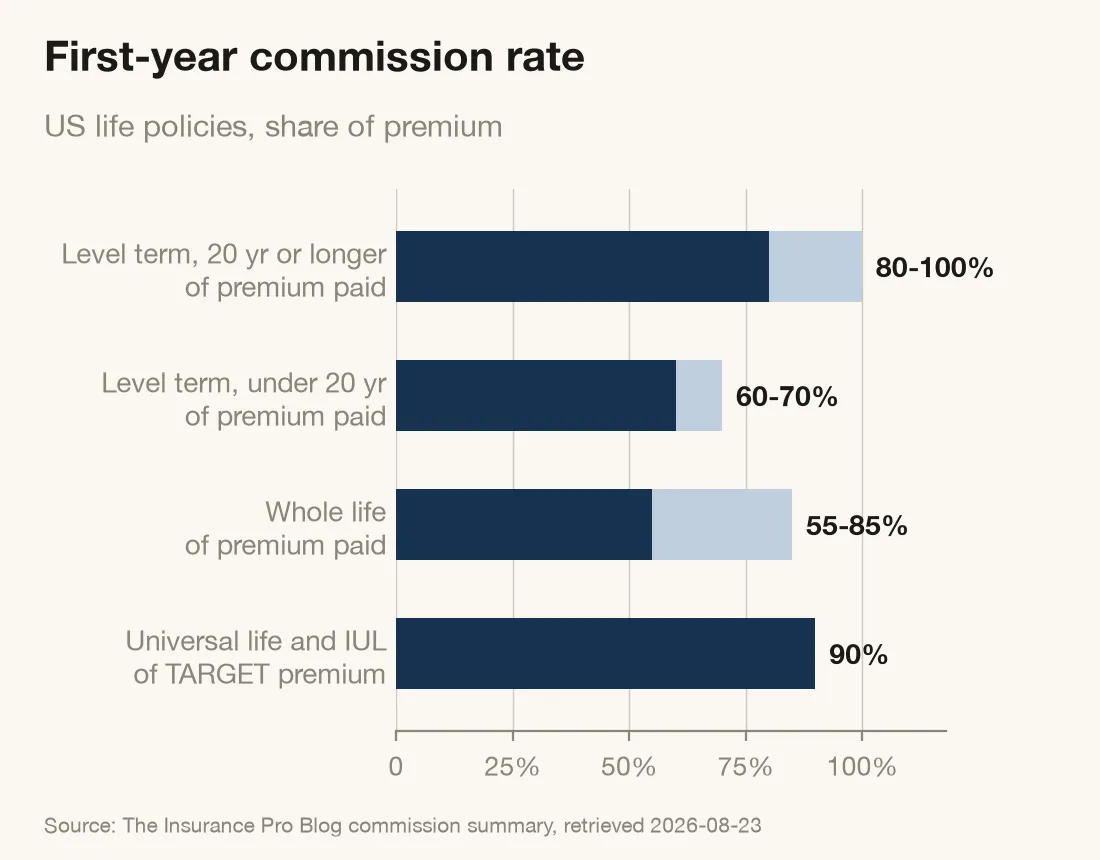
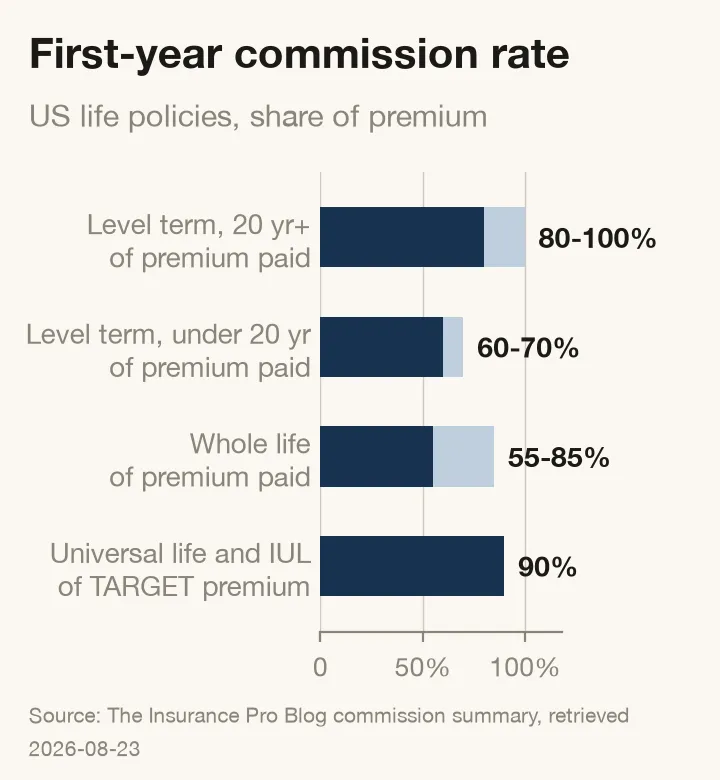
First-year agent commission rates for US life insurance products, as ranges. Universal life and indexed universal life rates apply to a carrier-set target premium rather than to premium paid. Rates are industry ranges. Actual rates vary. Source: The Insurance Pro Blog commission summary (updated 2026-04-11).
These commission rates can work out to be sizeable, depending on the policy type. This is the real reason why insurance sales reps want you to have these products.
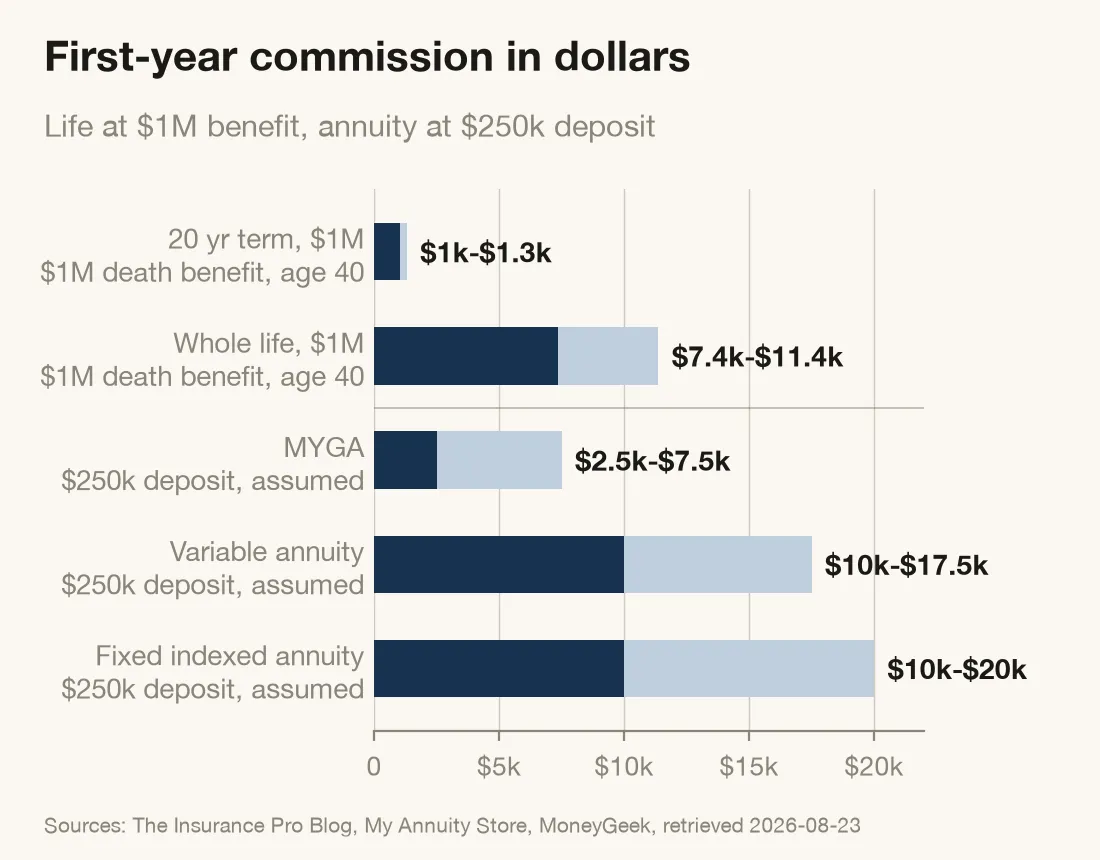
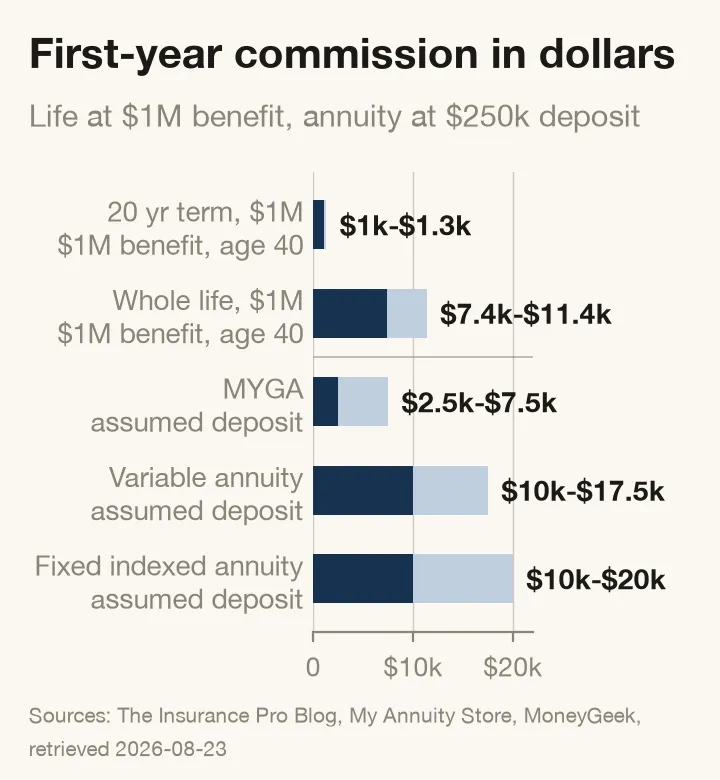
First-year agent commission in dollars. The annuity rows apply published rates to an assumed $250,000 deposit, not a quote, and are not comparable to the life rows. Sources: The Insurance Pro Blog, My Annuity Store, MoneyGeek, retrieved 2026-08-23.
Insurance product types
Let’s go back to this word salad of life insurance product types. They start out simple and rapidly ramp up in complexity.
- Term life insurance. The simplest option. You pay a premium for a fixed number of years. If you die during that term, your family gets a lump sum. If you don’t, they get nothing.
- Whole life. Like term life, except it lasts your “whole life”. Part of each premium goes to a cash value that grows at a guaranteed rate, and policies from mutual insurers may also pay a non-guaranteed dividend. Note: this is the first of many life insurance products that incorporate an investment aspect alongside the risk mitigation aspect.
- Universal life. Like whole life, except you have flexibility to change your premium. The more premium you pay, the bigger your cash investment account grows. The less you pay, the smaller it grows. And if you let the cash value get too small, the policy will abruptly lapse and terminate.
- Indexed universal life. Like universal life, except instead of a stated growth rate, your cash investment account grows relative to an index, such as the S&P 500 domestic stock index. The growth rate is subject to myriad caps, floors, and calculation rates. Basically a terribly complex and expensive S&P 500 ETF with no dividend payments stapled onto a life insurance policy.
- Variable life. Like indexed universal life, except your money is actually invested this time. Instead of a formula that credits you something based on an index, you pick from a menu of mutual-fund-like subaccounts. These subaccounts do not have the floor protection of IUL policies. Basically a terribly complex and expensive 401k system stapled onto a life insurance policy.
- Variable universal life. Variable life insurance that adds the flexibility of changing premiums found in universal life policies (see above). This one goes beyond stapling investment products onto life insurance policies. At this point, we’re stapling a small life insurance policy onto a terrible investment product.
Why I hate almost all of these products
Complexity and buried fees. I listed the products above in a specific order. Every product listed after simple term life insurance increases in complexity by adding extra layers of investment products alongside the core insurance benefit. These investment products are, without exception, duplicate versions of “normal” investment products. Just with more fine print, higher costs, and worse performance.
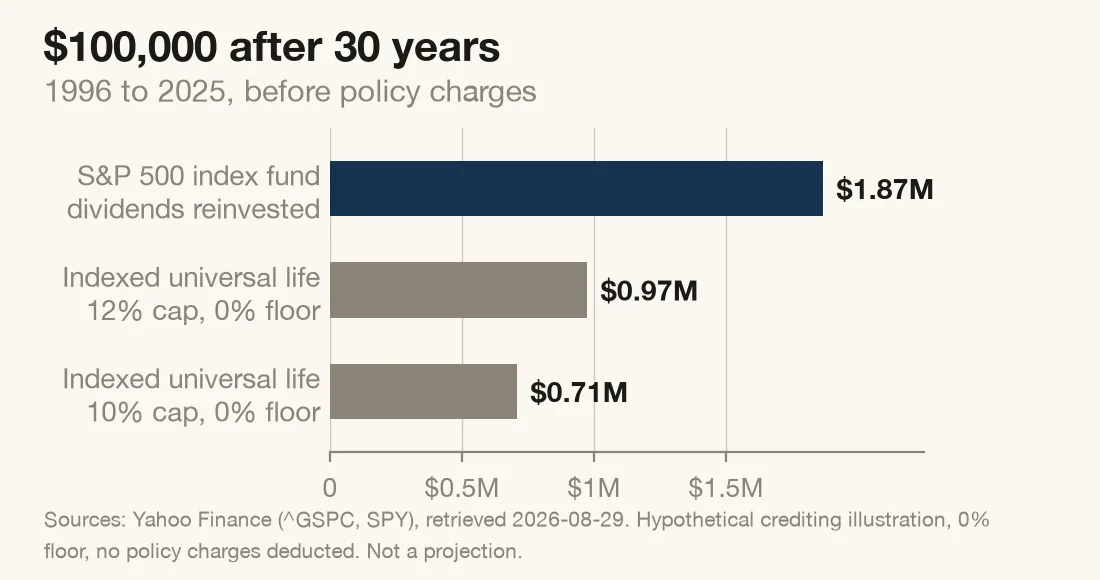
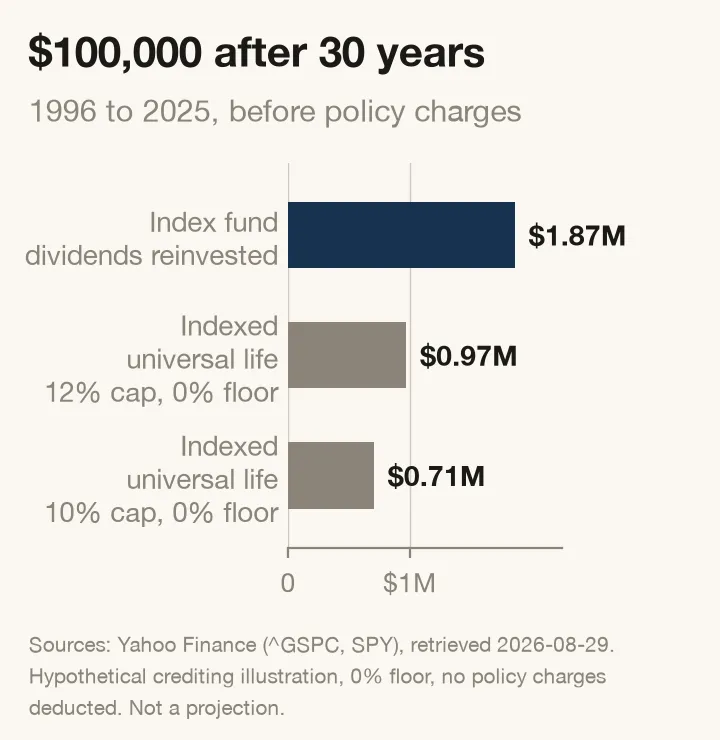
Consider below, a hypothetical Indexed Universal Life policy that offers to mirror the S&P 500 stock index, with the return credited to the policy floored at 0%, in exchange for an annual return cap of 10%. It’s not even close. The IUL cash account is simply a terrible mockery of a plain S&P 500 index fund.
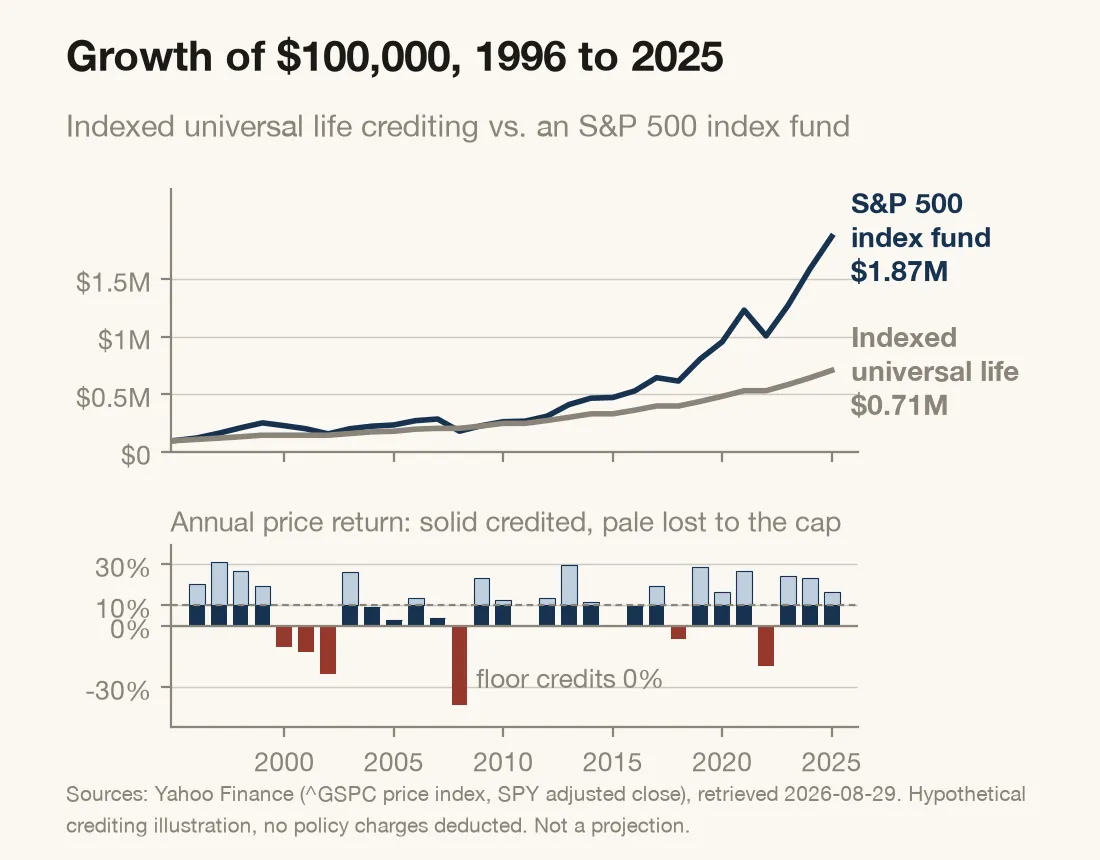
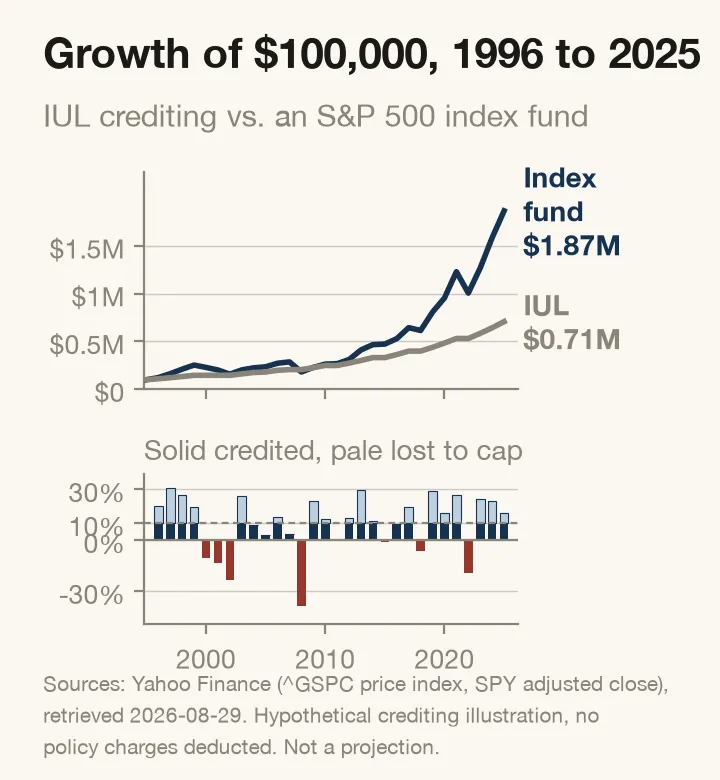
The indexed universal life series credits each year’s S&P 500 price index return with a 0 percent floor, a 10 percent cap and a 100 percent participation rate. The index fund series is the total return of SPY with dividends reinvested, net of the fund’s own expenses. No policy charges are deducted from the indexed universal life series. Not a projection and not the result of any actual policy. Sources: Yahoo Finance (^GSPC price index, SPY adjusted close), retrieved 2026-08-29; cap rate ranges from The Insurance Pro Blog and IULvsWholeLife.com, retrieved 2026-08-29.
The chart above is a good illustration of how bad these “stapled on” investment products are. A 0% investment return floor sounds nice, but when you factor in the returns cap, you’re giving away a huge part of the benefit of owning the US stock market. The cap and the floor are simply not set at a fair level.
The missing dividends in IUL policies are a factor here too. The IUL return calculation formula follows the S&P 500 price index, which excludes dividends, and over this period that came to about 1.9 percentage points a year. It turns out to not matter that much, because so many years have returns above 10% anyway. When the return is above 10%, the dividend is irrelevant, because the total return is getting stolen away, not just the dividend. In other words, the missing dividends don’t get a chance to hurt your returns all that often because the cap is so damaging.
On top of that, the insurer can often lower the cap! Industry caps ran 12 to 13 percent in 2019 against 8 to 9 percent on most new-issue products in 2026. Which is mind boggling because the analysis above shows how much of a rip-off even a 10% cap is.
Finally, all of the analysis here is before insurance fees, which would make the insurance product look even worse.
The tax treatment argument
Insurance reps typically respond to the poor performance of these IUL products with their advantages of tax-free growth and tax-free access to funds. However, for many investors, there are much cheaper options to shield returns from taxes, such as qualified retirement accounts or IRAs. Even if those aren’t an option, or if those options are maxed out, you’re just paying a huge chunk of your return to an insurer rather than the IRS.
And the tax-free access isn’t ideal either. To “access” your funds, you borrow against the cash value, you never repay the loan, and the death benefit settles the balance when you die. That does work. But the fine print is that the loan accrues interest, the borrowed balance compounds for as long as you live, and if the policy ever lapses with a loan outstanding, all the gain you avoided paying tax on comes due at once as ordinary income.
Finally, a regular taxable brokerage account isn’t always a tax disaster. While you’re alive, a buy-and-hold index fund generates qualified dividends and only triggers long-term capital gains on the shares you actually sell. And under current law as of 2026, whatever is left when you die passes to your heirs with a stepped up basis, wiping out the gain that accrued inside the account. That isn’t identical to an insurance policy loan, but it can provide its own tax advantage without the damaging cap, without decades of cost of insurance, and without a policy that can lapse with penalties.
So let’s give the insurance product every possible advantage and re-run our analysis. In the chart below I’ve fully taxed the brokerage account. It pays 15% on its dividends every year, and when it sells shares to fund spending it pays 15% long-term capital gains. The IUL policy pays no taxes, no loan interest, and no insurance fees. Both accounts fund the exact same $17,974 a year starting in 2016. The brokerage account handed over $52,310 in taxes across those thirty years and still finished with two and a half times as much money as the IUL policy. There is simply no tax treatment that makes the IUL policy look OK, because the cap on returns is simply too damaging.
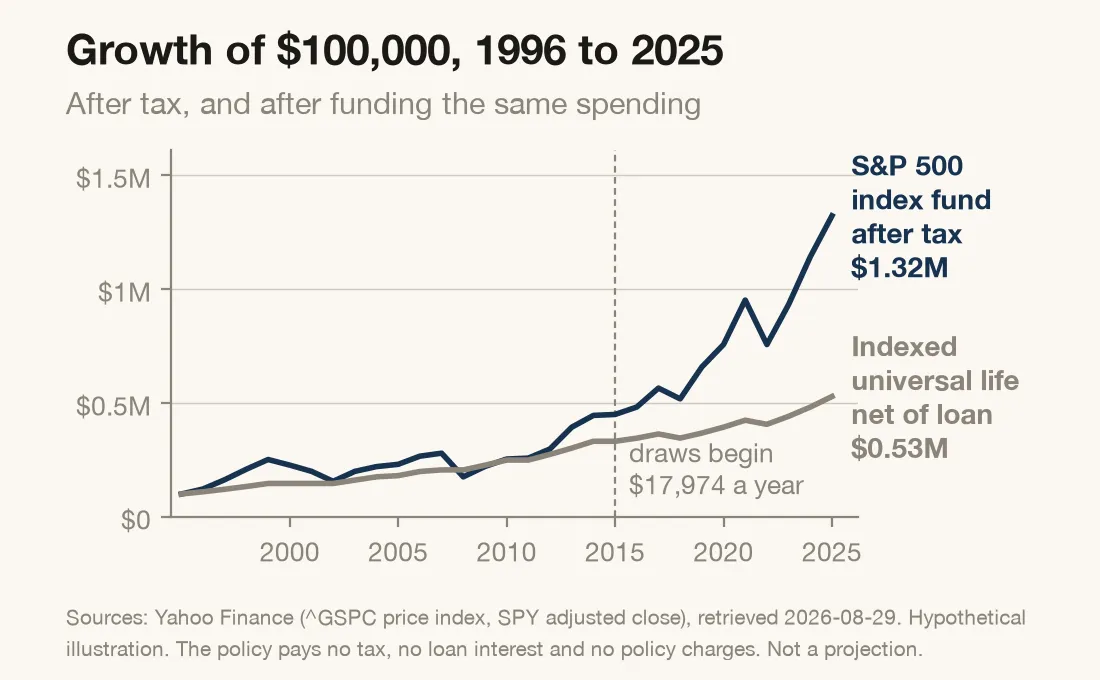
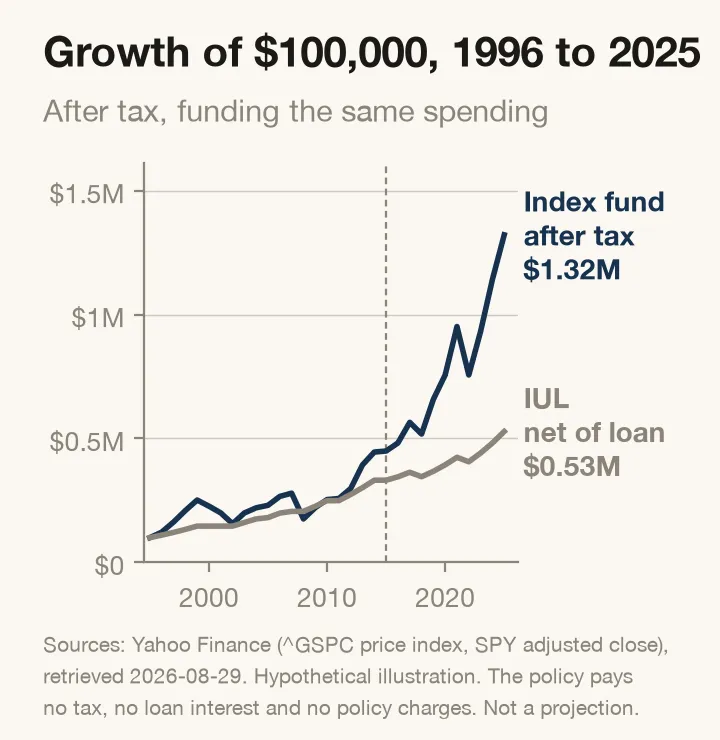
Both accounts start at $100,000 in 1995 and accumulate untouched through 2015. Drawdowns begin in 2016, and from then through 2025 both accounts fund the same $17,974 a year. The index fund account pays 15 percent on qualified dividends each year and 15 percent long term capital gains on the gain portion of each sale, federal only, with no state tax and no net investment income tax. The indexed universal life series credits the S&P 500 price index return with a 0 percent floor, a 10 percent cap and a 100 percent participation rate, and funds its spending with a policy loan carrying no interest. No policy charges are deducted. Not a projection and not the result of any actual policy. Sources: Yahoo Finance (^GSPC price index, SPY adjusted close), retrieved 2026-08-29.
Situations where life insurance does make sense
Term life for mitigating the risk of income loss
Many households, especially young families, have a primary income source tied to one parent. If that parent dies, that household’s finances will be in disarray. That risk needs to be mitigated. You can mitigate that risk by buying a term life policy on the person with that income source, with a term matching either the time-to-retirement for that person, or the period in which risk needs to be mitigated. The product is simple and offers from different insurers are readily comparable. You still pay a pretty big commission, but you’re mitigating a catastrophic risk.
Specific estate planning situations
There are several estate-specific reasons to use various life insurance products to mitigate taxes. This isn’t my area of expertise, so if an estate planner recommends it, it’s probably fine. Just make sure you’re dealing with an estate planner recommending an insurance product, and not an insurance salesperson holding themselves out as an estate planner.
Most other situations
In most other situations, life insurance is a bad investment product and you will do fine just refusing it. You don’t need to be a source of commissions for the insurance sales rep.
Questions to ask before buying life insurance
If you’re already in a conversation with an insurer, here are some questions to ask them.
- What is your total compensation on this sale in year one, in dollars, and in each renewal year?
- What is guaranteed and what is projected on this illustration?
- Would you show me the same case funded with term plus a taxable investment account similar to this product?
- What happens if I surrender the policy after 3 years? (This gets at surrender charges.)
Happy to help
If you’re considering purchasing a life insurance product that hasn’t been covered here, or if you would like some help evaluating insurance choices you’re looking at, or (even better) if you’d like some help resisting an insurance sales rep, please contact me and I’d be happy to help you evaluate it, at no cost or obligation to you.