Are Trump Accounts Good Investment Vehicles?
Bottom line up front: Take the freebie thousand dollars in your Trump Account, but invest the rest of your money for your kids in a 529 and then a UTMA.
Trump Accounts are a new retirement investment account that went live in July 2026. Most media and industry coverage of Trump Accounts has focused on the free $1,000 that parents of kids born in 2025 through 2028 can get as a special contribution from the federal government. Free money woo! But beyond the free one-time contribution, it’s unclear if these Trump accounts offer advantages over traditional investment vehicles for children, notably UTMA (Uniform Transfer to Minors Act) accounts.
To compare these two accounts, I’m going to take a look at both, and specifically I’m going to look at both through the lens of the “Kiddie Tax” treatment that both accounts are subject to.
One quick note, I’m not going to compare these accounts to one additional child savings vehicle, a 529 college savings plan. In general, I think a 529 is a better investment vehicle for children that should be prioritized over either a Trump Account or a UTMA. More information can be found in an earlier article of mine, Investment Accounts for Children.
What’s a Trump Account
Trump Accounts were established by the Working Families Tax Cuts in July 2025. With some important exceptions, they are kind of like a Traditional IRA for a kid. They are opened online at trumpaccounts.gov by a parent or guardian. Notably, accounts that are created for kids born in 2025 through 2028 get a freebie $1,000 tax-free donation from the federal government automatically. This freebie also does not count toward any account contribution limits. Parents and friends of the child can contribute to the account up to the child’s 18th birthday, and the money is mostly penalty-locked in the account until the child is 59 and 1/2 years old. Investments are limited to a US equity ETF, although details are still being sorted out.
Contribution Limits
There are several different contribution limits for Trump Accounts. Total contributions are $5,000 per year, and that single limit covers parents, relatives, friends, and employers alike. Inside that $5,000, the employer of the parent or child can contribute up to $2,500 per year pre-tax. Contributions from parents, relatives, and friends are after-tax. In other words, parents, relatives, and friends do not get a tax deduction for contributions.
In addition, there are a few contribution sources that are not subject to any limits. Notably, special contributions from federal, state, and local governments, and non-profits. All of these contributions must apply equally to classes of recipients, such as whole zip codes, etc.
Finally, all of these limits will be inflation adjusted in the future.
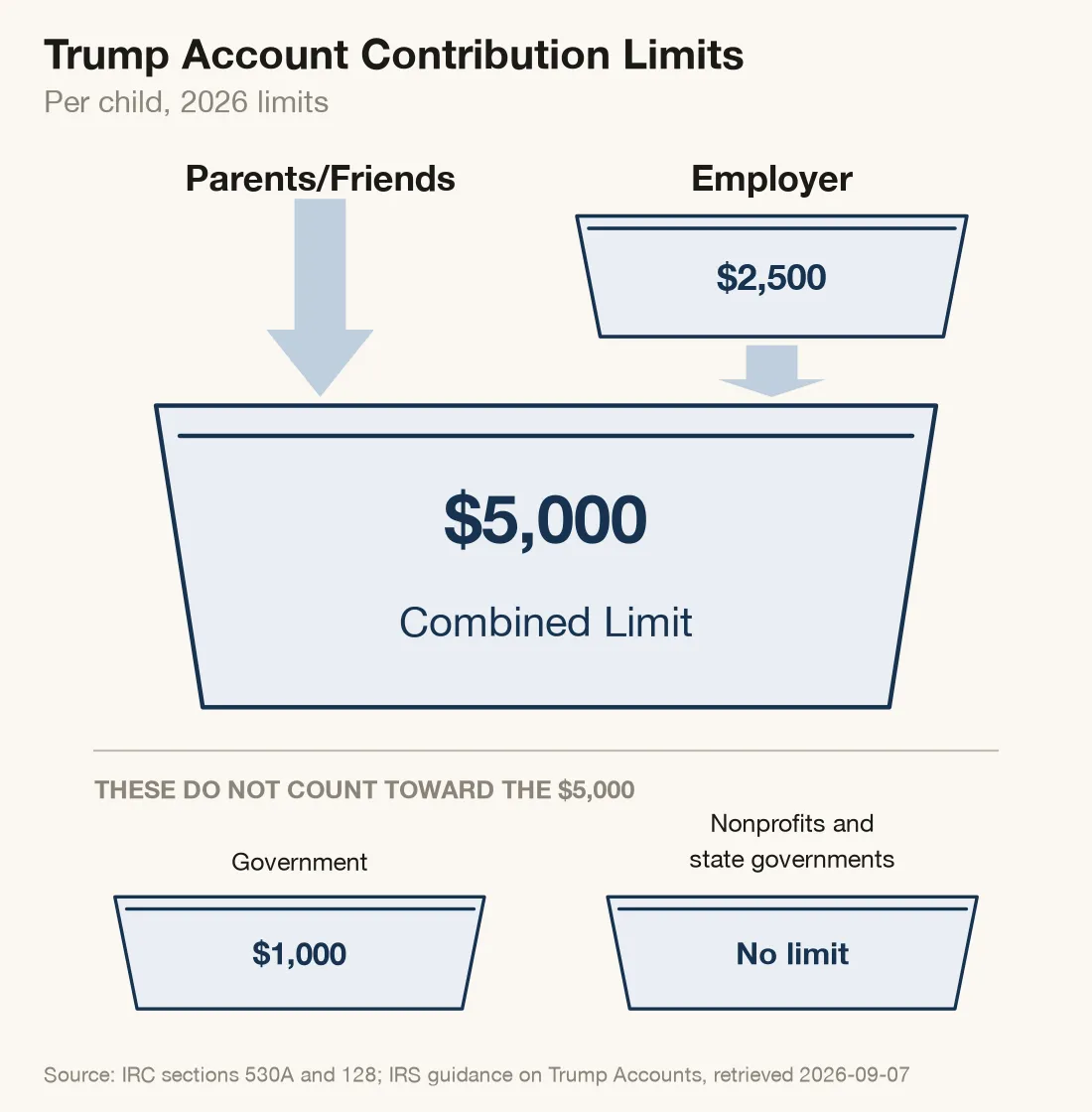
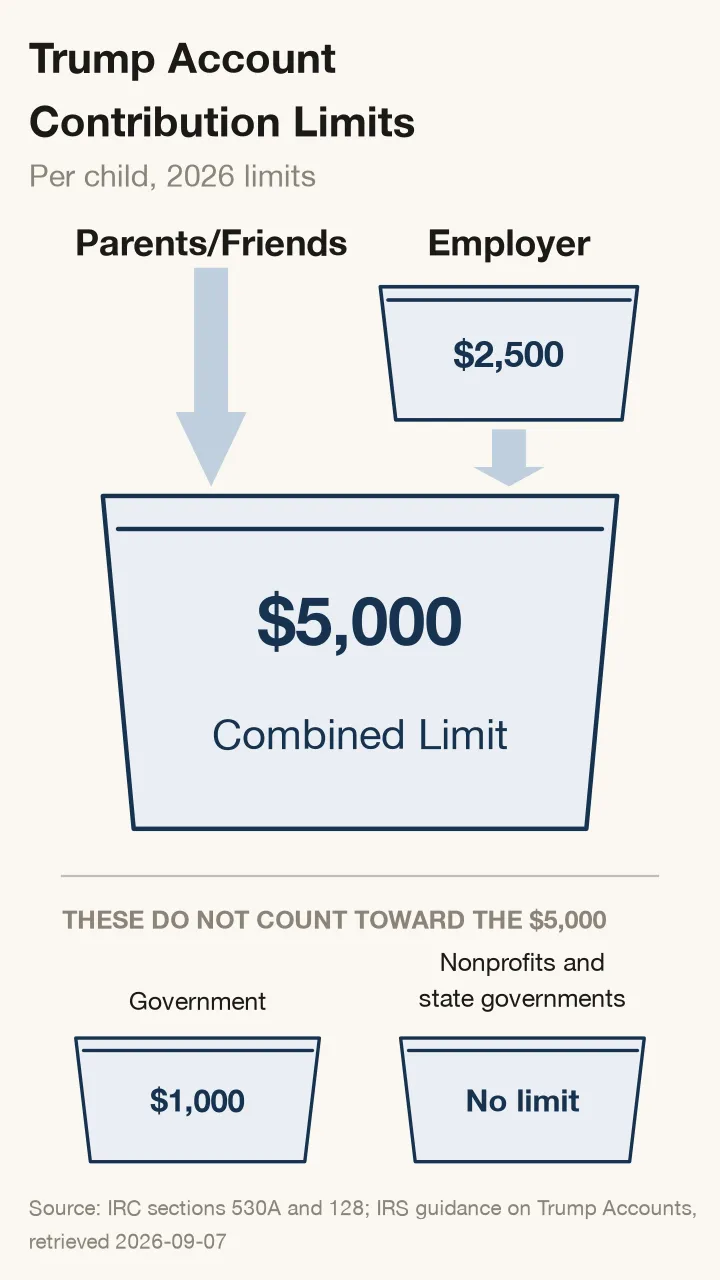
What can be contributed to a Trump account in 2026. Individual and employer contributions share one $5,000 annual limit, and the employer’s share is capped at $2,500 per employee across all of that employee’s children. The $1,000 Treasury deposit and qualified general contributions from nonprofits and state or local governments are exempt contributions and do not count against it. Source: IRC sections 530A and 128, IRS guidance on Trump Accounts, retrieved 2026-09-07.
The “goodness” of a retirement account comes down to taxes
Trump Account taxes on the way in
- Employer, government, and non-profit contributions are pre-tax
- Parent, relative, and friend contributions have no tax deduction or benefit
- So, for parent’s purposes, no tax benefit on the way in
Trump Account taxes on the way out
- Basis (contributions that were taxed on the way in) comes out tax-free
- Everything else is ordinary income on the way out
- 10% penalty on distributions before 59½ in addition to ordinary income tax
But! Think about the ratio of contributions (basis) of an account that has been invested since you were a toddler when you are now 59 and 1/2. In the model I run below, basis is about 3% of the account at that point and growth is the other 97%. So if you highly utilize a Trump Account, there will be very little tax advantage on the front end and also very little tax advantage on the back end.
How does this compare to UTMAs?
UTMAs are basic, fully taxable, investment accounts for kids. They are basically a brokerage account that you set up for a kid. Custody and control of the account goes over to the kid at an age of majority set by state law, most commonly 21, though some states use 18 and others let you extend it further. UTMAs are generally thought to have no tax benefit. Because there is no tax benefit, there are no contribution limits and no early withdrawal penalties.
UTMA taxes on the way in
- No front-end tax benefit whatsoever, everything is after-tax
UTMA taxes on the way out
- Long-term capital gains on anything sold at any time
- Qualified dividend rates on all dividend income throughout the life of the account
- Reinvested dividends are new purchases with new tax basis
The key tax difference between a Trump Account and a UTMA
For parents who want to put a meaningful amount of money away for their kids in one of these accounts, the question is which tax treatment is better. At withdrawal, Trump Accounts incur a lot of regular income tax at the child’s current tax bracket. In contrast, at withdrawal, UTMAs incur a lot of capital gains. And separately, UTMAs incur a small amount of dividend tax liability throughout the life of the account.
It might seem like the extra dividend taxation weighs heavily against UTMAs. However, a set of rules commonly known as kiddie tax treatment impacts Trump Accounts and UTMAs very differently in a way that disadvantages Trump Accounts and (very slightly) advantages UTMAs.
The “Kiddie Tax”
What is the Kiddie Tax
The Kiddie Tax rule is tax code adopted in 1986 that is designed to prevent high net worth parents from stashing income-producing assets with their kids to take advantage of their kids’ low income tax brackets. It states that for un-earned (passive) income for minors, a small slice of that income is tax-free, another small slice is taxed at the child’s income tax bracket, and the rest is taxed at the parents’ income tax bracket. In 2026, those slices are at $1,350 and $2,700 of passive income.
The Kiddie Tax works nicely with a UTMA
For investments in a UTMA, as long as the account custodian is not actively selling securities inside it for a gain, the only taxable income generated is dividend income. And UTMA accounts invested in broad US equity funds have to get pretty big before dividend income gets above even the freebie slice of the Kiddie Tax rule.
For example, if an ETF has a dividend payout rate of 1.5%, the account won’t throw off more than the $1,350 tax-free slice until it grows past $90,000 in value. And the next $1,350 slice is taxed at the child’s own bracket, which for qualified dividends is 0%, so in practice the first $2,700 of dividends escapes tax entirely all the way up to $180,000 of account value. Even at $5,000 in contributions per year, it takes a while for the account to get that big.
Additionally, when the account is smaller than that, taxable gains can be deliberately harvested up to the Kiddie Tax limit to increase the tax basis of the account, and reduce future capital gains tax liability. This effect isn’t large, but it’s a small tax benefit that can be utilized in a UTMA.
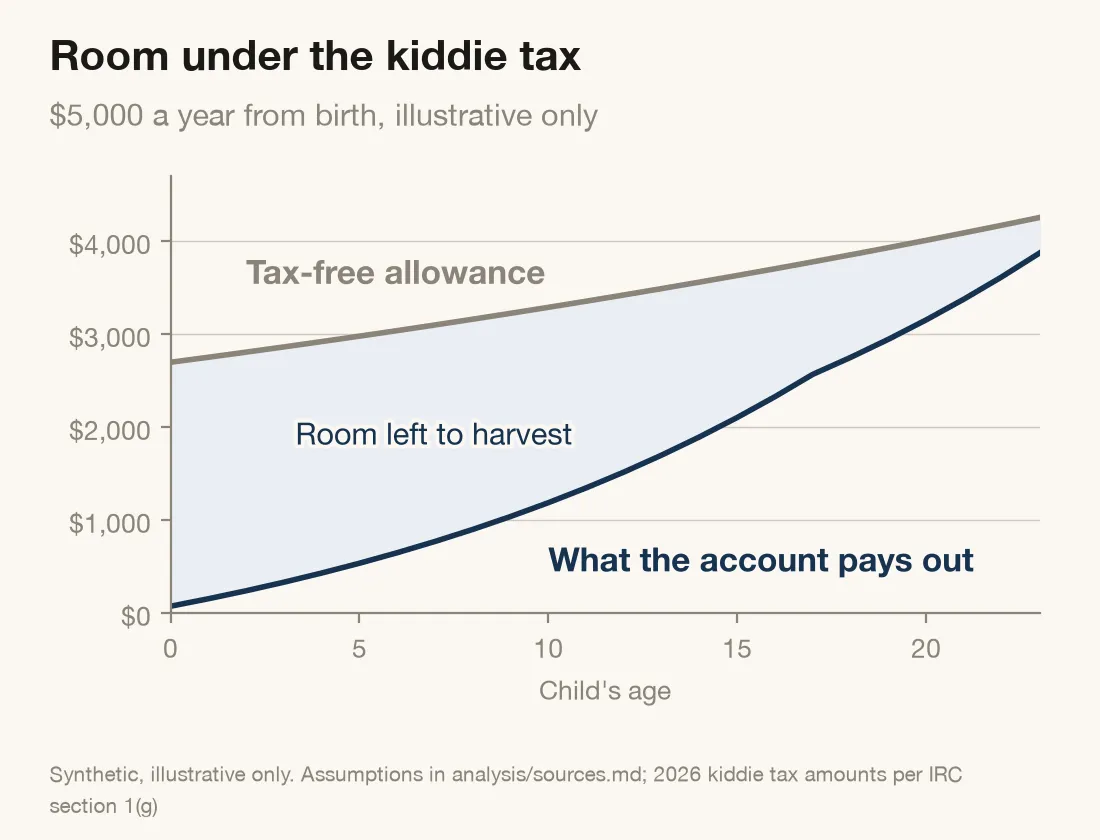
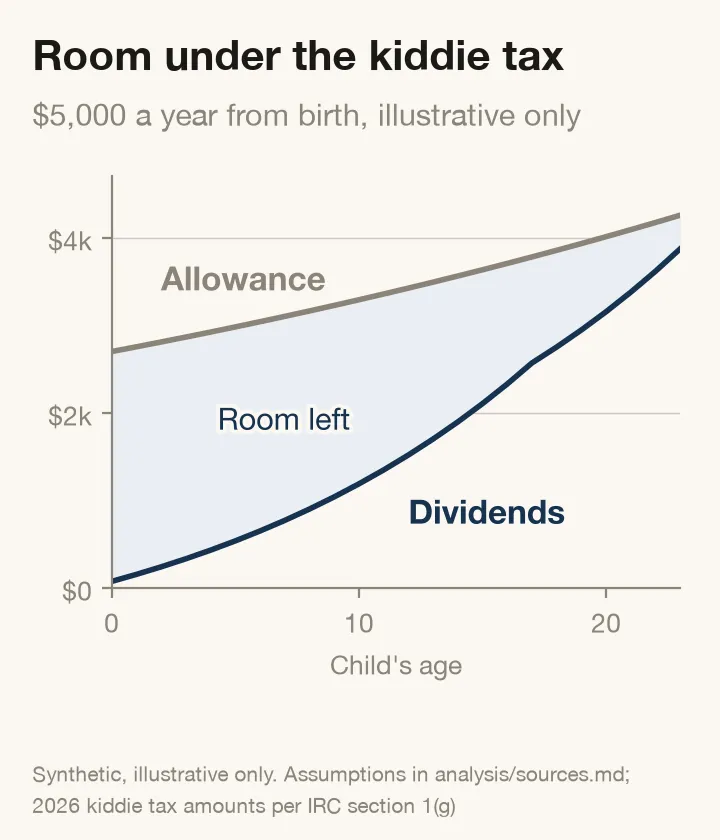
Unearned income a child can receive each year without tax under the kiddie tax, against the qualified dividends thrown off by a custodial account funded at $5,000 a year from birth. The shaded area is allowance the dividends do not use, which is the gain that could be realized at no tax. The 2026 allowance of $2,700 is modelled as rising 2 percent a year. Source: IRC section 1(g), 2026 amounts.
The kiddie tax works against Trump Accounts
Trump Accounts aren’t so lucky. The main tax mitigation strategy you would use with a Trump Account would be Roth conversions, which are allowed. The idea would be to progressively convert some Trump Account holdings to a Roth IRA when eligible, which would incur regular income tax. However, the Kiddie Tax rule constrains how much can be converted at the child’s low tax bracket. When you run out of Kiddie Tax allowance, you’re converting to Roth at the parent’s rate, which is probably high, resulting in probably the worst possible tax timing. This all happens because the IRS considers Roth conversions to be un-earned income, just like dividends.
That isn’t good.
What it looks like over a full holding period
Here’s a rough comparison, using the same contributions, same investment, and same holding period. I looked at five options:
- Plain Trump Account
- Trump Account using Roth conversions while the child is a student, at ages 19 to 23
- Trump Account using Roth conversions after school, at ages 24 to 30
- Plain UTMA
- UTMA managing basis through the Kiddie Tax allowance
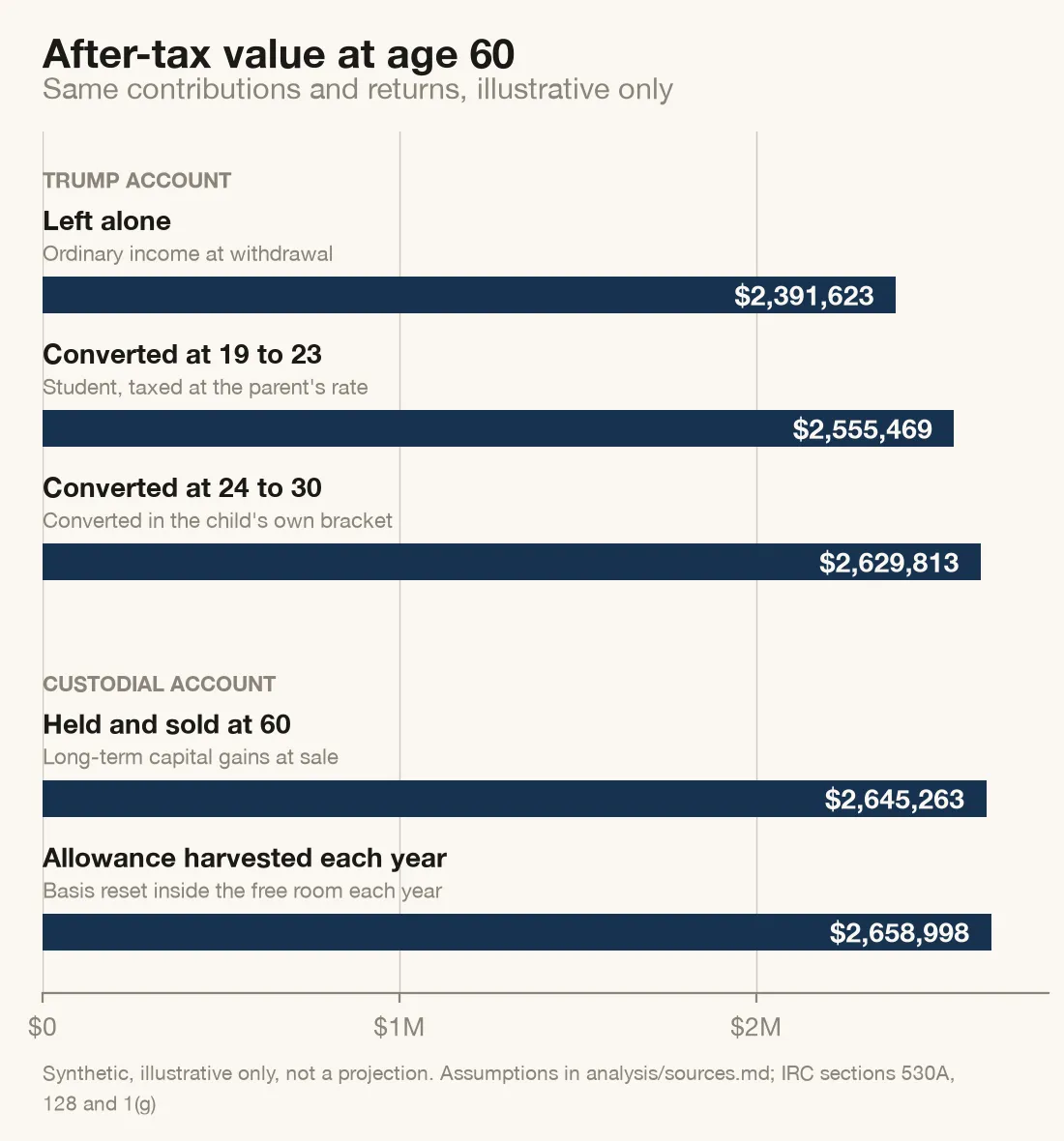
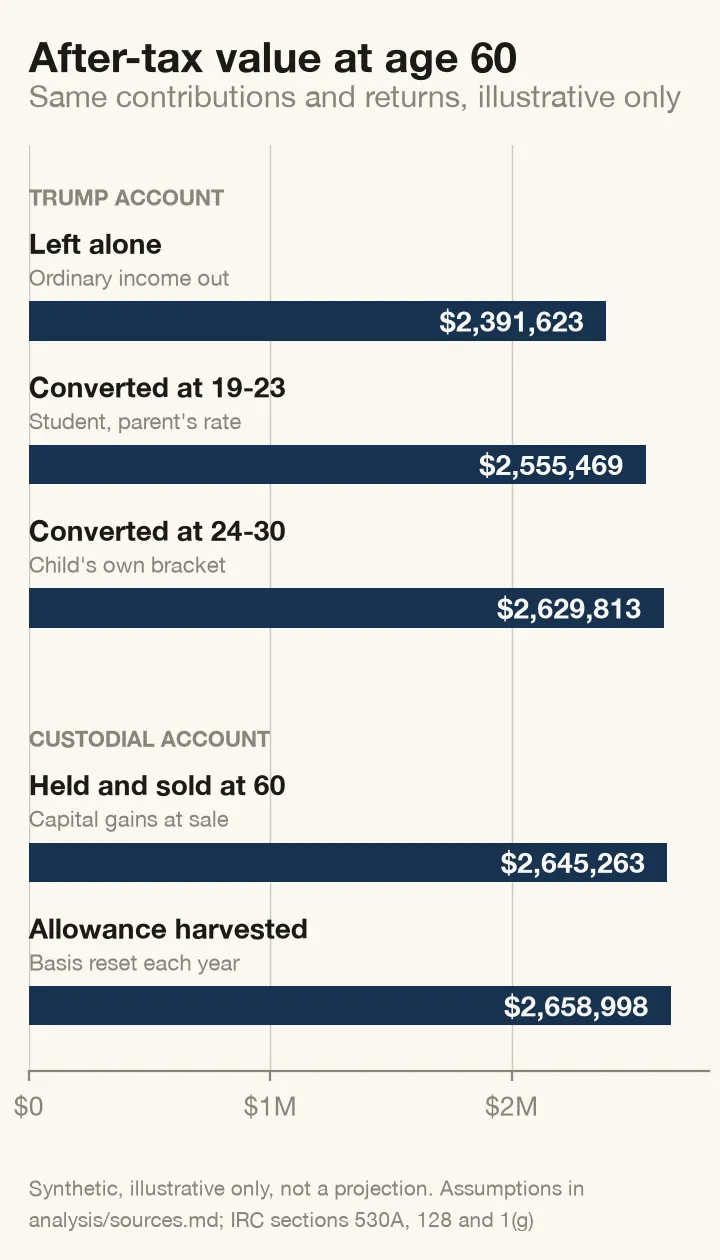
After-tax value at age 60 of $5,000 a year contributed from birth through age 17. All accounts hold the same index fund at an assumed 7 percent total return. Synthetic and illustrative only, not a projection. Source: IRC sections 530A, 128 and 1(g).
The key takeaway from this analysis is that an un-managed Trump Account doesn’t do very well, but all of the other options basically end in a tie. A carefully managed Trump Account with strategic Roth conversions does just about as well as a UTMA, and the UTMA Kiddie Tax strategy provides a very small benefit.
So if a simple, un-managed UTMA account works so well, why bother with the lock-up of a Trump Account? Keep it simple and use a UTMA.
So what does all this mean?
Like everything, this all comes down to individual circumstances.
But let’s look at the analysis. Under diligent tax management, both strategies perform similarly on an after tax basis. With no tax management, the UTMA clearly outperforms.
Beyond that, a Trump Account largely locks up money behind penalties until the holder turns 59 and 1/2. A UTMA has no penalty structure.
So, I expect for most of my clients, I will be recommending they take the freebie thousand bucks in the Trump Account, and then do the rest of their children’s investments in the usual mix of 529 plans and a UTMA. Note: I haven’t discussed 529 plans much here, but I do think they should usually be a priority over both Trump Accounts and UTMAs because of their beneficial tax treatment on both the front and back end.
Credit where credit is due
I learned a lot about this topic through a Continuing Education article at Kitces.com, “Why Taxable Custodial Accounts Are Better Than OBBBA “Trump Accounts” For Kids’ Savings”. It’s behind a paywall, but if you’re in the industry, it’s a great article, and I’m a big fan of Kitces for continuing ed. No affiliation, I just like it. The comparison analysis here is my own, but I wanted to make sure to give credit to a great resource and a source of education and background info for me.
Sorting this out for your own kids?
I really like talking to my clients about this sort of thing. If you’d like to discuss investment accounts for kids further, please don’t hesitate to reach out and we can take a look together.